The Difference is in the Details
When was the last time you looked at a LinkedIn profile image and it brought a smile to your face, or thought you’d want to meet this person? And what was it about that image that evoked that feeling?
It’s in the details of the image – first, the lighting needs to be done correctly. There’s no specific formula, but we know that certain types of lighting works better than others. Overhead fluorescent lighting, or midday sun pointed directly at the person’s face gives people “racoon eyes” – i.e., dark circles under their eyes. That type of lighting is technically called “hard lighting” – it creates shadows on the face that have a sharp falloff. That amplifies crevices in the skin, making them look more prominent. That’s not to say you don’t want any shadows – shadows give shape and form to the face, but you want those shadows to be controlled and deliberate for the look you’re going for and the person’s facial features.
The background should be complimentary to the image and its usage. A solid color background directs the eye towards the person’s face (your brain just ignores the background as there’s no information there other than color/brightness). Some people like to have an office/lab/or outside scenery as a background – that’s a matter of style/look, but you generally want the background to be out of focus otherwise it can “compete” with the person’s face/image. You also want to ensure there are no objects in the background that appear like they’re growing out of the person’s head.
But one of the most important elements in creating a feeling is the expression on the person’s face – and how genuine it looks/feels. Remember your high school yearbook picture (or do you try to forget it!)? That fake smile that looks like you had something bad to eat or couldn’t wait for the photographer to take the picture? It’s no wonder many people would rather have a colonoscopy vs. having their headshot taken – they’ve rarely seen a picture of themselves they like.
When many people smile in front of the camera, it doesn’t often look like how they generally smile for real. With a real smile, their eyes smile along with other facial muscles. Unless you’re an actor, or have practiced smiling in front of a camera, it’s difficult to create that real smile without some assistance.
That’s where the photographer plays a huge role – coaching, cajoling, and knowing when to capture that moment where the smile looks genuine (in addition to the proper camera angle, lighting, etc.).
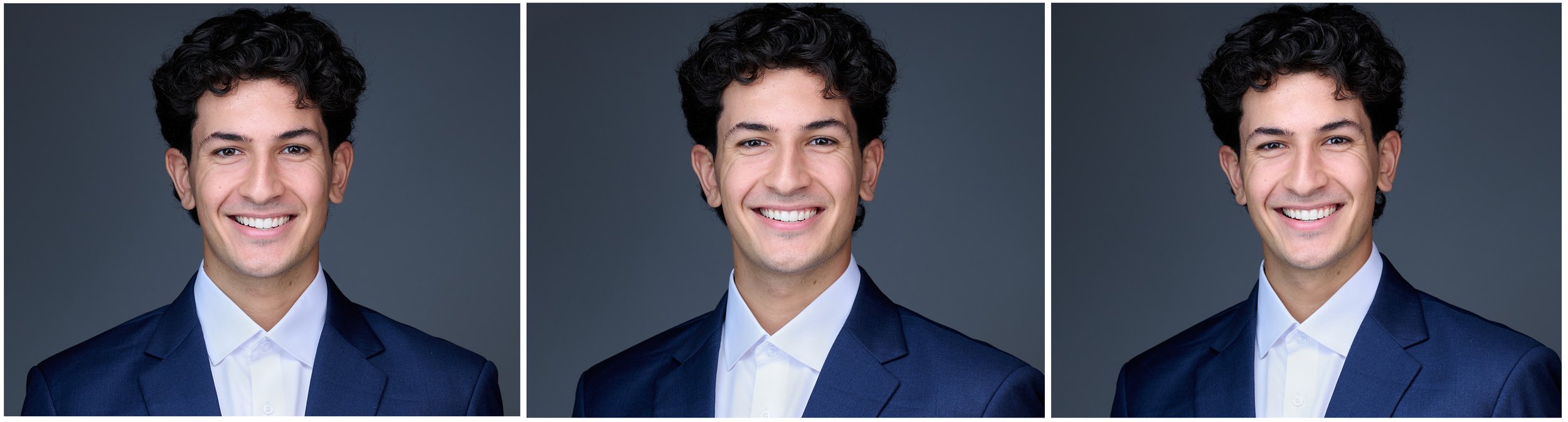
Luke is a new hire software engineer at a long-time client of mine, Hyannisport Research – they’re a high technology networking company, with hardware and software engineers making up the majority of their team. Their DNA/corporate culture values (among other things) that “details matter” and “quality is non-negotiable”. The headshots of their team reflect those values.
Look at the images below – they’re all good, better than you would likely get with a selfie, or having a friend take the shot, or AI generated. But one of the images stands apart and looks more genuine. There’s a touch more energy in the image to the right – the eyes are smiling a touch more, along with the facial muscles. You feel the difference in energy.
Which is the best image to use? Any of them by themselves would be great choice – and at the end of the day, it comes down to a personal preferences. And once that image is posted somewhere, you won’t have the others to compare it to.